The stag beetle
The UK’s largest beetle, written more than one official way
A fact list, a body-text sentence, and a caption share a page and do not say the length in quite the same words. This desk keeps all three, and does not invent a fourth.
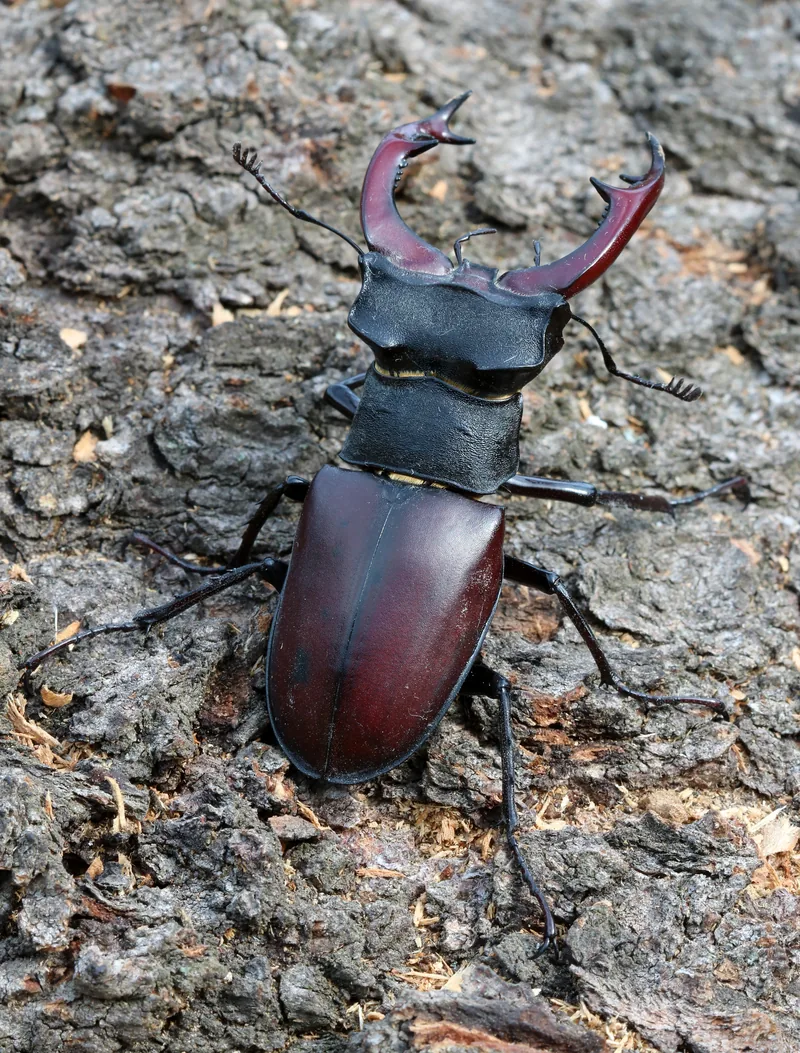
How long is a stag beetle?
The Natural History Museum’s stag-beetle fact list is exact in millimetres, “including mandibles/jaws”: males 35–75 millimetres long, females 30–50 millimetres long. Weight is given as 2–6 grams. Average lifespan is given as 3–7 years. The species is native, and “partially protected,” with an IUCN category of “Near Threatened on the European Red List of Saproxylic Beetles.” [source]
The same page’s body text writes the male length in centimetres: “Male stag beetles measure up to 7.5 centimetres long when their impressive jaws are taken into account, making this species the largest beetle in the UK and in fact the whole of Europe.” [source] Those two statements describe the same official upper end, written two ways. They are kept, and they are not averaged with a third sentence.
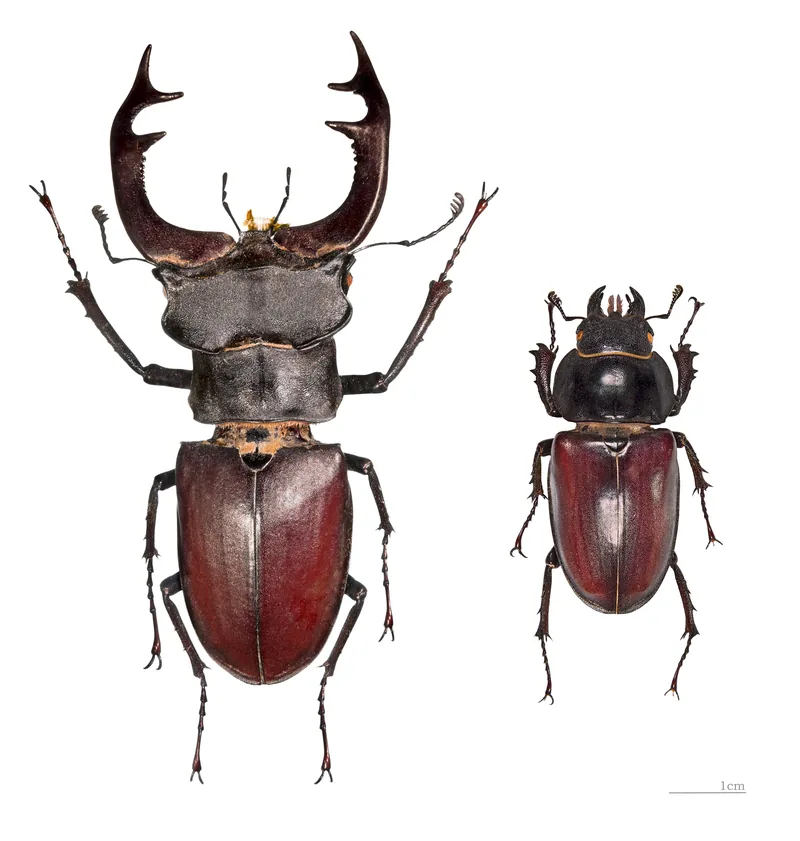
The third sentence is a photograph caption on that page: stag beetles “are the largest beetle not just in the UK but in Europe. The males can measure nearly 8cm long.” [source] This desk logs that caption, and it does not treat “nearly 8cm” as a third official length, or as a reason to move the fact list or the 7.5-centimetre sentence. The museum specimens above, a male and a female at the Muséum de Toulouse, simply show why the jaws matter to a measurement.
Other official sizes on the same page sit beside those figures without replacing them. “The smallest males are about four centimetres long.” Females “can be as little as three centimetres long.” The biggest-beetle page, written for a different article, says females “grow to about five centimetres long, whereas males have large mandibles and can reach 7.5 centimetres.” [source] [source] Those wordings are reported as they stand.
Years as a larva, weeks as an adult
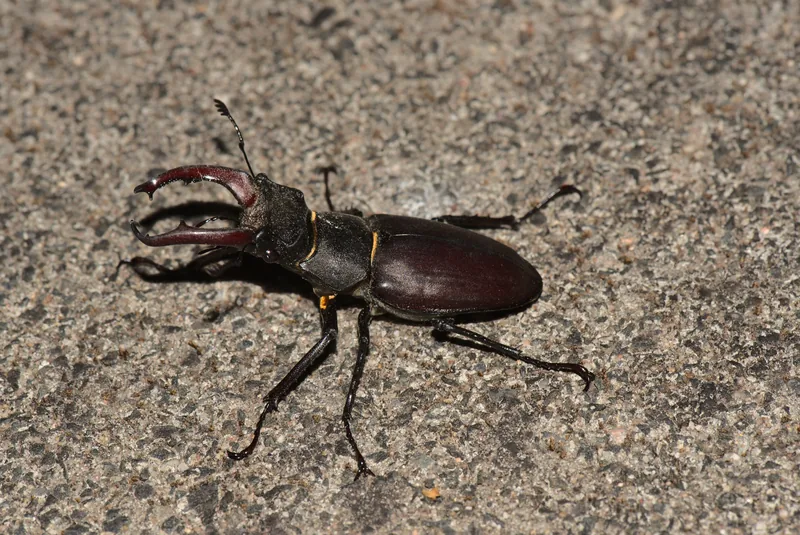
Time is also written two official ways. On the biggest-beetle page, “stag beetle larvae spend up to six years feeding on the rotting wood the female laid her eggs in.” “When the larvae pupate and transform into adults, they then feed only on tree sap and live for about eight weeks.” [source] The stag-beetle fact list, on the other official page, gives “Average lifespan: 3-7 years.” [source] This desk does not average six years with 3–7 years, and it does not rewrite “about eight weeks” as “a few weeks.” The field notes keep the two clocks in one place.
The stag-beetle page also says “Stag beetle larvae feed on dead wood, using their sharp jaws to scrape the fibrous surface for splinters.” In the UK they “mainly live in southeast England, although they are locally common along parts of the southwest coast and in the Severn Valley,” and “are most abundant around the Thames Valley, the New Forest in Hampshire and down to the south coast.” [source]
Protection, in the official wording
The museum says the stag beetle is protected under the Wildlife and Countryside Act 1981, and that “the protection aims to prevent the beetle from being collected for sale.” [source] Schedule 5 of that Act lists “Beetle, Stag (in respect of section 9(5) only)” and the scientific name Lucanus cervus. [source] This site quotes both, and it does not turn that wording into a general rule about moving a beetle off a path. It is not legal advice.
For context, the same stag page gives the next UK size rivals without letting them rewrite the stag figures: the great diving beetle “can reach about three centimetres long,” and the European rhinoceros beetle “can be nearly six centimetres long, although two to four centimetres is more usual.” A rhinoceros beetle “discovered in the UK for the first time in 2013, in a Worcestershire garden,” has “no evidence that a population has established.” [source]
Enjoyed this desk on which familiar names are beetles, and which official glow-worm is not?
No pop-ups. No intrusive advertising. Just interesting stuff. A little support helps the next critters.im site get built.